
Recombinant Galectin-3

(View Recombinant Galectin-3 Data as PDF)
Galectin-3 is a carbohydrate-binding protein, a lectin, that binds glycoproteins containing ß-galactoside. It has multiple biological functions, but its relevance in cardiac diagnostics is its involvement in inflammation, fibrosis, and ventricular remodeling.
Myocardial injury triggers an inflammatory and wound healing response. As part of this process, macrophages release galectin-3, which then binds to and activates myofibroblasts, resulting in collagen synthesis. The collagen deposits lead to the development of myocardial scar tissue and ventricular remodeling, both of which significantly increase the likelihood of future myocardial dysfunction or heart failure.1
Galectin-3 is well-studied and is strongly linked to long-term outcomes in cardiac patients.2,3,4 Several studies confirm galectin-3’s role in predicting future cardiac events, including the decades long, multi-generational Framingham Heart Study.5
Elevated blood levels of galectin-3 can help establish a diagnosis of heart failure and are strongly associated with higher mortality rates in both acute and chronic heart failure patients. Over time, galectin-3 levels correlate strongly with patient outcomes. Lower levels are associated with an event-free future, while higher levels correspond with increasing severity of heart disease. In addition, elevated levels identify increased risk for heart failure in healthy, middle-aged adults.
In addition, galectin-3 assay data are complementary with those from natriuretic peptides, such as N-terminal pro-B-type natriuretic peptide (NT-proBNP). In short, NT-proBNP levels are elevated when the heart is undergoing myocardial stretch, an indication that the heart is straining and working harder than it normally would. This can occur in conditions like hypertension, cardiac ischemia, or heart failure. Therefore, NT-proBNP provides a snapshot of what is currently happening in the heart, while galectin-3 is an indicator of what may happen in the future. Together, they guide treatment decisions made by a cardiac care team.
SDS-PAGE
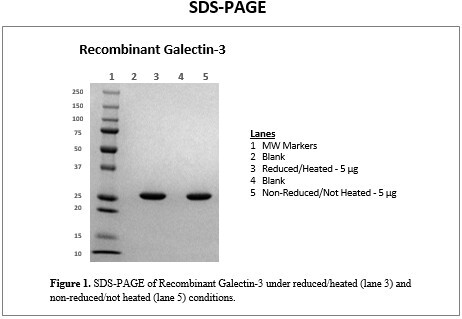
Figure 1 presents an SDS-PAGE image of purified recombinant galectin-3 from Scripps Laboratories. The purified protein runs close to its predicted MW of 26 kDa.6 As can be seen in the gel, no visible contaminants are present.
HPLC
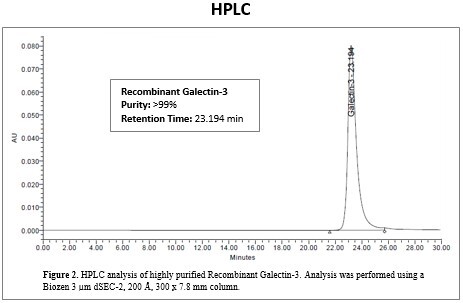
The HPLC elution profile for recombinant galectin-3, is shown in Figure 2. The chromatogram reveals a clean, single peak, indicative of a highly purified protein. Recombinant galectin-3 eluted at 23.194 minutes, with a purity >99%.
Purified galectin-3 is suitable for use in a research setting or in the development of a clinical diagnostic assay. It is expressed without the use of affinity tags and purification is performed using traditional chromatographic methods.
Recombinant Galectin-3 is in stock and available now:
T0522-90708 - Recombinant Galectin-3, ≥95%
References
(1) BaniHani, Khaled, Al Sharaa, et al. Cureus, 2025; 17(3): e81264.
(2) Zaborska, Sikora-Frac, Smarz, et al. Int. J. Mol. Sci. 2023; 24: 13111.
(3) Bastos, Colaco, Baptista, et al. J. Mol. Cell. Cardiol. Plus. 2025; 11: 100290.
(4) Netala, Hou,, Wang, et al. Int. J. Mol. Sci. 2025; 26: 3218.
(5) Ho, Liu, Lyass, et al. J. Am. Coll. Cardiol. 2012; 60(14): 1249-1256.
(6) UniProt ID P17931UniProt ID P17931