
Recombinant AFP

Alpha-Fetoprotein (AFP) is a 68-70 kDa glycoprotein belonging to the α1-globulin family of plasma proteins. It is produced by the fetal liver and yolk sac during pregnancy and production drops sharply postpartum.
AFP testing of serum or amniotic fluid from expectant mothers is useful as a screening tool for neural tube defects and chromosomal abnormalities. It is usually part of a test panel that also includes human chorionic gonadotropin, inhibin-A, and unconjugated estriol. AFP is also valuable as a tumor marker, as it is elevated in hepatocellular carcinoma and germ cell tumors.
Recombinant AFP from Scripps Laboratories is offered as a high-quality, economical replacement for the native protein. Native AFP is purified from human umbilical cord serum and is subject to the unpredictability of the human tissue and fluid supply chain networks. Recombinant AFP from Scripps is produced in the mammalian cell line, CHO. It is a glycosylated form of AFP and can be produced in large scale.
RECOMBINANT AFP DATA
View data as a PDF: Recombinant AFP data
View products: Recombinant AFP, ≥95% | Recombinant AFP, ≥50%
HPLC
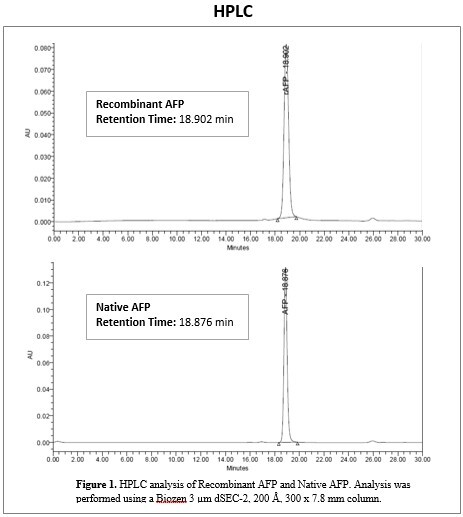
Analyzed by HPLC, the elution profiles for Recombinant AFP and Native AFP show nearly identical retention times, indicating the two molecules exhibit similar chromatographic behavior under the conditions tested. Figure 1 shows Recombinant AFP eluting at 18.902 minutes and Native AFP eluting at 18.876 minutes. The difference between these retention times is <0.14%, which is well within assay-to-assay and lot-to-lot variation. Furthermore, both peaks show no shoulders, reflecting a high level of purity.
WESTERN BLOT
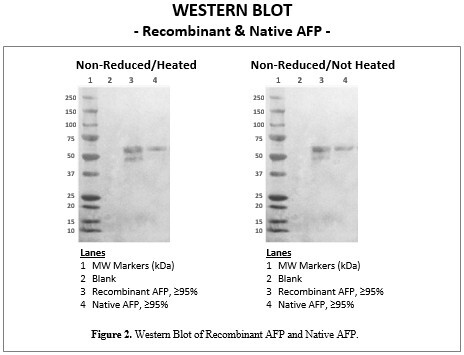
Figure 2 shows western blot analysis of Recombinant and Native AFP. A lower molecular weight variant is seen with Recombinant AFP (lane 3 in both gels). Staining with the Scripps Laboratories anti-AFP monoclonal antibody (Mat. No. MA075-90173) confirms the identity of the variant band to be AFP.
SDS-PAGE, GLYCOPROTEIN STAIN
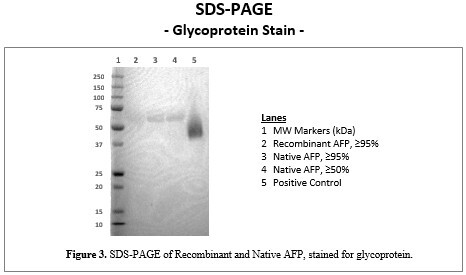
AFP contains one primary N-glycosylation site at Asn251.(1) The glycoprotein staining of Recombinant AFP and Native AFP is shown in Figure 3. The weak staining seen with both the recombinant and native forms of AFP is consistent with the presence of a single glycosylation site.
The data presented here indicate Recombinant AFP is a suitable replacement for Native AFP. The two proteins are very similar in both molecular weight and purity. In addition, both proteins contain a modest amount of glycosylation. Recombinant AFP has the advantage of being produced at manufacturing scale, making it a cost-effective alternative to the native protein.
Recombinant AFP is in stock and available in two grades:
A0732-90721 - Recombinant AFP, ≥95%
A0732-90721 - Recombinant AFP, ≥50%